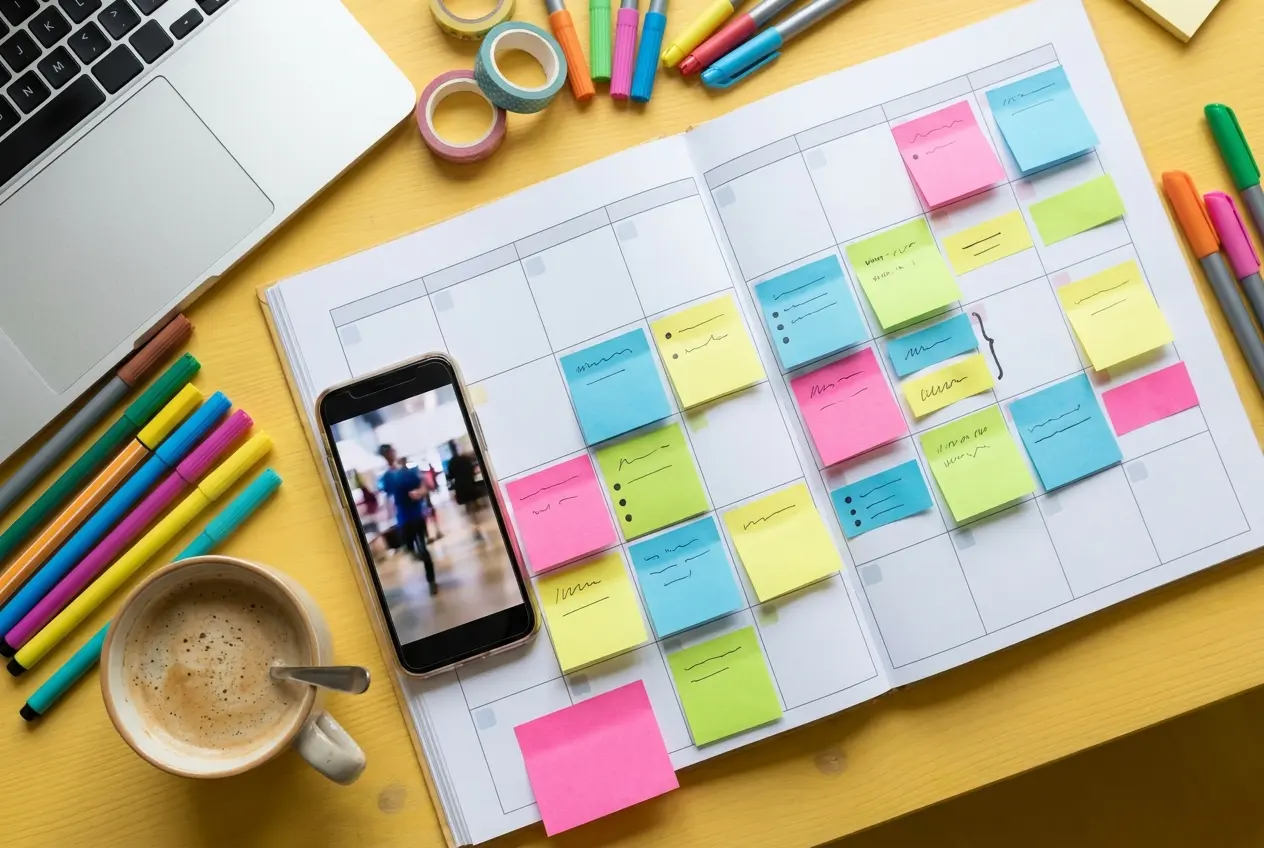
Your customers are spread across Instagram, YouTube, WhatsApp, email and marketplaces. Making content is rarely what trips D2C brands up. Getting the right piece onto the right platform at the right time is, especially when the team rebuilds the plan from scratch every Monday.
A social media content calendar sorts that out. Campaigns stay on track, the panic before every sale goes away, and over a few months you can see which posts bring clicks and orders. Below is how we build one for our clients, with a free template you can copy into Google Sheets.
Start with campaign themes, not posts
Decide the big themes for the month or quarter before you think about individual posts.
- Product launches and restocks
- Sales and offers
- Brand storytelling (founder, making-of, sourcing)
- Collaborations with creators or other brands
- Education: how to use, how to choose, routines
Themes keep the message consistent across platforms without copy-pasting the same post everywhere. Every post in the calendar should belong to one of them.
Plan around India's festive and sale moments
Shopping in India follows the festival calendar closely. We put these dates in first and plan backwards from each one.
- Diwali and the festive season: the biggest gifting and shopping window for most categories, from devotional and puja products to jewellery, perfumes and home decor.
- Raksha Bandhan: gifting for siblings; strong for jewellery, perfumes, bags and hampers.
- Wedding season: outfits, jewellery, makeup and gifting, with different peaks across regions.
- Valentine's week: couples' gifting, beauty and fragrance.
- End-of-season sales: clearing stock in fashion, bags and accessories, usually twice a year.
- Regional festivals: Onam, Durga Puja, Pongal, Baisakhi, Navratri and others, if your audience is concentrated in those regions. For on-ground ideas around these dates, see our experiential marketing ideas for Gen Z.
Teasers should start a few weeks before each moment, and the shoot needs to happen earlier still. A Diwali shoot booked in October almost always ends up rushed.
Give each platform a clear job
People use each platform for something different, so match the content to that.
- Instagram: discovery and community. Reels, carousels, Stories, collaborations with creators.
- YouTube: depth and search. Tutorials, reviews, behind-the-scenes, Shorts for reach.
- LinkedIn: founder and team stories, hiring, partnerships. Useful for B2B and investor visibility, rarely for direct D2C sales.
- WhatsApp and email: conversion and retention. Launch alerts, restocks, offers, order follow-ups.
- Facebook: often an ad placement more than an organic channel for D2C brands.
Build a format matrix
Plan formats platform by platform so you get variety without posting the same thing everywhere.
| Format | YouTube | WhatsApp / email | ||
|---|---|---|---|---|
| Short vertical video | Reels | Shorts | Sometimes | Link to the video |
| Carousel or slides | Yes | No | Yes (document posts) | No |
| Long-form video | No | Yes | Sometimes | Link to the video |
| Tutorials and how-tos | Reels, carousels | Full video | No | Short tip with link |
| Offers and launches | Stories, posts | Community post | No | Yes, main channel |
On most D2C calendars, short video does most of the work. If you need help turning one shoot into many edits, that's what our design and video editing team does every week.
Set a frequency you can actually keep
Pick a pace your team can hold. Posting steadily for months does more than a burst of daily posts. For a small team we'd start here.
- Instagram: 3 to 4 feed posts or Reels a week, plus Stories on most days
- YouTube: 2 to 4 videos or Shorts a month
- LinkedIn: 1 to 2 posts a week, if it matters for your brand
- WhatsApp and email: 2 to 4 campaigns a month
Treat these as a starting point rather than a benchmark, and adjust for your team, your library of photos and videos, and your budget. We'd much rather see a modest calendar that lasts six months than an ambitious one that falls apart in three weeks.
Your free content calendar template
Copy this content calendar template into Google Sheets, one row per post:
| Date | Platform | Format | Pillar / theme | Hook or caption draft | Asset link | Owner | Status |
|---|---|---|---|---|---|---|---|
| 2026-11-02 | Reel | Diwali gifting | "3 gifts under ₹999 she'll actually use" | Drive folder link | Content lead | In edit | |
| 2026-11-03 | Broadcast | Diwali gifting | Gift guide plus last order date for delivery | Gift guide link | CRM lead | Scheduled | |
| 2026-11-05 | YouTube | Short | How to use | 30-second routine with the new serum | Drive folder link | Editor | Planned |
We usually add a few more columns too: campaign name, paid boost (yes/no), UTM link, creator handle for collaborations, and a results column filled in a week after posting. Colour-coding by platform or status makes the sheet easier to scan.
Repurpose smartly, don't repeat
One idea can become several assets if you adapt it for each platform.
- A product shoot becomes Reels, carousel images, ad creatives and product page images
- A blog guide becomes a carousel, a Reel script and an email
- A creator review becomes a Reel, an ad, a Story and a product page video
Change the hook, length, captions and aspect ratio for each platform. Planning shoots with repurposing in mind is easier when you start from a checklist; our video production checklist for D2C brands covers it.
Schedule ahead and automate the follow-up
Pre-schedule posts with the native tools (Meta Business Suite for Instagram and Facebook, YouTube Studio) or the scheduling tool your team already uses. That keeps you consistent during sales, launches and holidays.
Then plan what happens after people engage. Comment-to-DM automation through Meta's official Instagram API can send a product link or guide to everyone who comments a keyword, and capture them as leads you own. Our marketing automation service sets this up with GNCreators.
Review monthly and feed the next calendar
At the end of each month, look at:
- The top three posts per platform, by saves, shares, clicks and orders, not just likes
- The best days and times for your audience
- Posts that didn't work, and a guess at why
- Which themes drove sales, and which only drove reach
Then use it to plan next month. Doing this every month is what makes the calendar useful beyond being a to-do list. If creators are part of your plan, read our influencer marketing strategy for product launches too.
FAQs
What should a social media content calendar include?
At minimum: date, platform, format, theme, caption or hook, asset link, owner and status. Adding UTM links and a results column turns it into a planning and reporting tool.
How far ahead should a D2C brand plan content?
Plan themes a quarter ahead and posts a month ahead. For big moments like Diwali or wedding season, plan shoots and creator collaborations six to eight weeks before.
How often should a D2C brand post on Instagram?
Whatever you can keep up without the quality dropping. For many brands that's three or four feed posts or Reels a week, plus Stories.
Can one shoot cover a month of content?
Often, yes, if you plan the shot list for multiple formats and platforms. A single well-planned shoot day can produce product images, Reels, ad creatives and Stories.
GrooveNexus Studios plans and runs content calendars for D2C brands, from strategy and shoots to editing and posting, through our social media management service. Send us your brief and we reply within 1 business day.