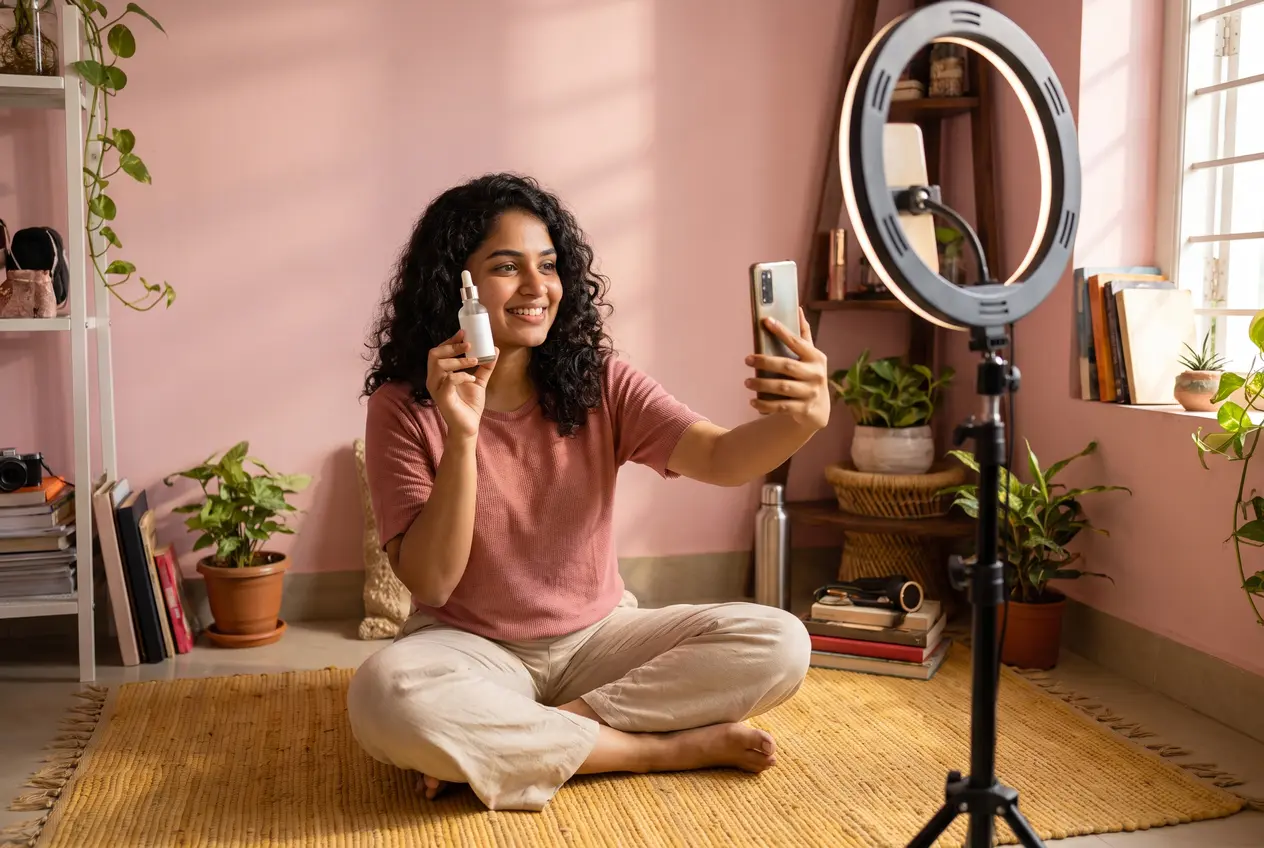
UGC means user-generated content: photos, videos and reviews made by real people rather than by a brand's own production team. A customer filming their first impression of your serum is UGC. So is a creator you've briefed to film an unboxing for your ads. For D2C brands in 2026, it's mostly the second kind people mean.
If you've seen a selfie-style video in your Instagram feed where someone opens a parcel, tries a product and talks straight to camera, that was almost certainly a UGC ad. Below we cover how UGC differs from influencer marketing, which formats suit which categories, and how we brief, license and measure it for brands. If you'd rather have a team run it end to end, that's what our UGC content service does.
Organic UGC vs creator-made UGC
The term covers two different things, and it helps to keep them apart.
Organic UGC is content your customers create on their own: a review on your product page, a story where they tag you, an unprompted haul video. It's the most believable content there is, but you can't control when it arrives, what it says or whether you're allowed to reuse it.
Creator-made UGC is content you commission. You pay a creator (sometimes called a UGC creator) to film videos or take photos in a natural, phone-shot style, to a brief, for your brand to use. The creator may never post it on their own profile. You use it in ads, on product pages and in emails. When marketers talk about "UGC ads" or "UGC videos" today, this is usually what they mean.
Most brands need both. Organic UGC builds social proof over time. Creator-made UGC gives you a steady, predictable supply of ad creative.
UGC vs influencer marketing
They overlap, and the same person can do both, but you're paying for different things.
| Aspect | UGC | Influencer marketing |
|---|---|---|
| What you pay for | The content itself | Access to the creator's audience (plus content) |
| Who posts it | Usually your brand, in ads and on your site | The creator, on their own profile |
| Follower count | Matters less; on-camera skill and category fit matter more | Matters, along with audience fit and engagement |
| Usage rights | The core of the deal, agreed in writing | Often limited unless you pay extra for them |
| Best for | Ads, product pages, testing many hooks | Awareness, launches, trust within a community |
If your goal is reach within a specific community, look at influencer marketing and our guide to influencer strategy for product launches. If you need ad creative that doesn't look like an ad, UGC is the better fit.
UGC formats and where they work
Different products need to be shown differently. These are the formats we use most, and the categories each one suits.
- Unboxing and first impressions. Good for anything where the packaging is part of the experience: perfumes, gift boxes, jewellery.
- Routine or how-to. Shows the product in use, step by step. Ideal for skincare and haircare.
- Try-on and swatches. Shades on real skin tones, fit on real bodies. Essential for cosmetics, clothing and bags.
- Honest review. A creator explains what they liked and who it's for. Works across categories, especially at higher price points.
- Problem to solution. Opens with a relatable problem ("my lipstick never lasts through lunch"), then shows the fix. Strong for ads.
- Talking head. The creator speaks to camera about one benefit. Fast to produce and easy to test with different hooks.
- Reaction. A genuine response to fragrance, texture or a reveal. Works for sensory products that are hard to show.
For more on choosing video types by category, see why every D2C brand needs product videos.
Where to use UGC
- Meta ads. UGC sits naturally in Instagram and Facebook feeds, Reels and Stories, so it tends to earn a few seconds of attention that polished brand films don't.
- Product pages. A short try-on or routine video near the "Add to cart" button answers questions a static photo can't.
- Emails and WhatsApp. A creator video in a welcome or abandoned-cart message adds a human voice.
- Your own social channels. Repost creator content (with permission) alongside your brand content.
How to brief UGC creators
A good brief gives creators structure without turning them into actors reading a script.
- The hook. Give two or three ideas for the first three seconds and let the creator pick the one that sounds natural in their voice.
- Talking points, not lines. List the three things that must come across: what it is, the main benefit, who it's for.
- Claims you can support. Only include claims you can back up. If you can't prove "clears acne in 7 days", don't let it be said on camera.
- Do's and don'ts. Pronunciation of the brand name, things not to compare against, how to hold the product, what to avoid showing.
- Technical basics. Vertical 9:16, good daylight, clean audio, and a few seconds of B-roll (close-ups of the product and texture).
- Language. Hindi, English, Hinglish or a regional language, depending on your audience.
Usage rights and whitelisting
This is where most brands get caught out. Before anyone films, agree in writing:
- Where the content can be used (ads, website, email, social, marketplaces).
- For how long (a fixed period, with an option to extend).
- Whether you can edit it (cut-downs, new hooks, captions, combining clips).
- Whitelisting, if you want to run ads from the creator's own handle. This needs separate permission and access settings on their account.
Without written rights, a great video can't run as an ad. Our post on influencer marketing mistakes covers this in more detail.
Disclosure
If a creator posts content about your brand on their own profile and you've paid them or sent free products, that's a material connection. India's advertising standards body, ASCI, expects such posts to be clearly labelled as advertising or a collaboration, and visible upfront. Check ASCI's current influencer guidelines before you launch. Content that only runs as ads from your brand's account is already clearly your advertising.
How to measure UGC
A few terms you'll see in Meta Ads Manager reports:
- Hook rate (thumb-stop rate): the share of people who watched the first few seconds out of everyone who saw the ad. It tells you whether the opening works.
- Hold rate: how many kept watching after the hook. It tells you whether the middle works.
- CTR (click-through rate): clicks divided by impressions. It tells you whether the video made people want to know more.
- CPA (cost per acquisition): ad spend divided by purchases. It tells you what each customer cost.
There's no universal "good" number for any of these. Compare videos against each other in the same account, keep the winners and refresh the rest. To see what those purchases are really worth after margin, read our guide to ROAS and break-even ROAS.
How to get UGC: DIY or with a team
DIY works when you're starting out. Ask happy customers for videos, reach out to a few creators directly, and test. It costs time: finding creators, negotiating, shipping products, chasing deadlines, sorting rights and editing. Our guide to barter collaborations is a good place to start if you're working with product instead of fees.
With a creator network or agency, you get a shortlist of creators who already fit your category, briefs and paperwork handled, and edits ready to launch. At GrooveNexus Studios we run UGC on top of our own creator network: you approve every creator and every final cut, and usage rights are agreed before filming. Because our team also edits ads and runs design and video editing for brands, each video comes with several hooks for testing.
Are you a creator who makes UGC? You can apply through our contact page by choosing Creator.
FAQs
What does UGC stand for?
UGC stands for user-generated content: content made by customers or creators rather than by a brand's own production team.
What is a UGC creator?
A UGC creator makes photos and videos for brands to use, usually in a natural, phone-shot style. Unlike influencers, they're paid for the content itself, and their follower count matters less than their on-camera skill.
Are UGC ads better than studio ads?
Neither is better everywhere. UGC tends to feel native in social feeds; studio content shows detail and quality. Most brands test both and keep what performs.
Do I need usage rights for UGC?
Yes. Agree in writing where you can use the content, for how long and whether you can edit it, before filming starts.
Can UGC be in Hindi or regional languages?
Yes. A creator speaking your buyers' language, whether that's Hindi, Hinglish, Tamil or Bengali, usually feels closer to them than a polished English script.
If you want a steady supply of UGC without the coordination work, see our UGC content service or get in touch. We'll reply within 1 business day.